Introduction to Nearshore Hydrodynamics

The mathematical problem we are now facing consists of solving the Laplace equation
| (3.2.1) | |
in the rectangular domain
| (3.2.2) | |
The boundary conditions are
The (kinematic) condition at the bottom
| (3.2.3) | |
The (linearized) kinematic condition at the mean water surface (MWL)
| (3.2.4) | |
The (linearized) dynamic condition at the MWL
| (3.2.5) | |
The periodicity condition giving the boundary condition in the x-direction. As mentioned, we have chosen to impose this condition on the horizontal velocity.
| (3.2.6) | |
To finalize the formulation we notice that the differential equation (3.2.1) governing the motion only contains the velocity potential ?, while the surface elevation ?, which is also an unknown of the problem, occurs in the two surface boundary conditions. This, combined with the fact that the Laplace equation only requires one boundary condition along each boundary] makes it necessary to eliminate ? between (3.2.4) and (3.2.5). This is accomplished by differentiating (3.2.5) with respect to t and adding to (3.2.4) which gives the condition for ? only at z =0.
| (3.2.7) | |
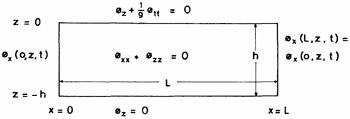
The physical situation is illustrated in Fig. 3.2.1, the mathematical formulation described above in Fig. 3.2.2.
We see that the formulation now represents a regular boundary value problem for the Laplace equation with ? as unknown. We also note that this problem is linear (linear equation with linear boundary condition).
It turns out that solution...