Introduction to Nearshore Hydrodynamics

Chapter 10: Boundary Layers

10.1 Introduction

One of the most important discoveries in fluid mechanics was the fact that vorticity is not generated inside a normal flow. It always originates from disturbances along some boundary or discontinuity in the flow. This causes boundary layers to develop. The boundary layer is the layer with significant vorticity due to the large velocity gradients in the direction perpendicular to the boundary.

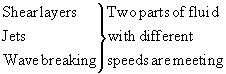
Examples of vorticity generating flow phenomena are:

Boundary layers at solid walls.


Boundary layers can be both laminar and turbulent, but they will always start laminar.

In nearshore regions, the boundary layer that develops at the sea bottom in the oscillatory motion caused by the waves (and currents) is of particular interest as it accounts for substantial energy dissipation when active over longer distances. The bottom shear stress may be small locally in comparison to other forces acting on the fluid column, but as the waves travel the energy dissipation due to bottom friction accumulates. The bottom boundary layer also plays a central role in how the waves and currents move sediments.

Also, internal "boundary layers" such as the vortex sheets that develop when the jet from a breaking wave hits the water in front of the crest are of importance. However, so far, nobody has been able to give a rational analyzes of those details that are of any significance for our understanding of the processes and even less of practical use.

Here we only consider boundary layers along plane walls and concentrate on the...

UNLIMITED FREE
ACCESS
TO THE WORLD'S BEST IDEAS

SUBMIT
Already a GlobalSpec user? Log in.

This is embarrasing...

An error occurred while processing the form. Please try again in a few minutes.

Customize Your GlobalSpec Experience

Category: Turbine Flow Meters
Finish!
Privacy Policy

This is embarrasing...

An error occurred while processing the form. Please try again in a few minutes.