Introduction to Nearshore Hydrodynamics

One of the most serious problems in coastal engineering is the disastrous erosion of beaches that often occurs during heavy storms. In a few hours, large amounts of material is removed from the beach and at first deposited as bars at some distance from the shoreline.
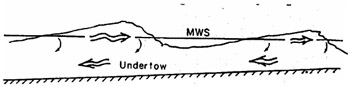
Though it has not yet been finally proved, this process is likely to be linked to the strong seaward oriented current flowing in the lower part of the water column under breaking waves. This current, called the undertow, is fed by the water volume brought shoreward by the volume flux of the breakers. In the two-dimensional situation on a long straight beach shown in Fig. 12.1.1, the two fluxes are equal. In cases with a horizontal circulation, the undertow will be superimposed on a net current. Inside the surf zone the amount of water carried shoreward in the roller of the breaking waves is further increasing the volume flux in such a wave relative to the ordinary volume flux in the waves, as found in Chapter 5.
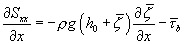
As found earlier (see Section 11.7.2), in the longshore uniform case the cross-shore depth integrated, time averaged momentum balance reads
| (12.1.1) | |
where ? is the set-up, ? b the mean bottom shear stress, S xx the radiation stress.
In the strictly 2D circulation flow shown in Fig. 12.1.1 ? b normally is a small term ( O