Introduction To Nuclear And Particle Physics, Second Edition

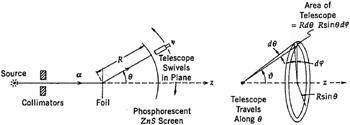
Let us now see how we would go about performing a measurement in order to extract a cross section. Macroscopically, we have a beam of ?-particles (Geiger and Marsden used a collimated source of ?-particles from a sample of radioactive radon), a thin foil, and some scintillating material for detecting the scattered particles. This was, initially, a thin coat of ZnS phosphor deposited on a glass screen, and viewed by eye through a telescope. The telescope was able to rotate in one plane and thereby trace out the counting rate as a function of ? (but not
). Schematically, the apparatus can be represented as in Fig. 1.4.
Now, if we have our flux of N 0 ?-particles per unit area per second impinging on the thin foil, then some of these will pass through essentially undeflected, while others will be scattered through an angle between ? ?d ? and ?, corresponding to impact parameters between b+db and b. Here d ? can be regarded as the angle subtended by the aperture of the telescope. In fact, the telescope views a small area of the screen given approximately by Rd ? Rsin ?d
=R 2 d ? , where R is the distance from the foil to the point of observation on the screen. The scattered particles that appear in...