11.2 Parity
As mentioned in previous chapters, parity, otherwise known as space inversion, is a transformation that takes us from a right handed coordinate frame to a left handed one, or vice versa. Under this transformation, which we denote by the symbol P, the space-time four-vector changes as follows:
| (11.1) | 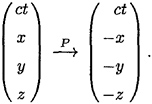
|
It is important to recognize that the parity operation is distinct from spatial rotations because a left handed coordinate system cannot be obtained from a right handed one through any combination of rotations. In fact, rotations define a set of continuous transformations, whereas the inversion of space coordinates does not. It is clear therefore that the quantum numbers corresponding to rotations and parity are distinct.
Classically, the components of position and momentum vectors change sign under inversion of coordinates, while their magnitudes are preserved
| (11.2) | 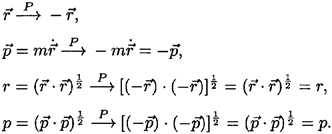
|
This defines the behavior of normal scalar and vector quantities under space inversion. There are, however, scalar and vector quantities that do not transform under parity as shown in Eq. (11.2). Thus, for example, the orbital angular momentum, which changes like a vector under a rotation of coordinates, and which we therefore regard as a vector, behaves under space inversion...


 TABLE OF CONTENTS