The spherical Bessel functions j ?( x) arise in solutions of the radial Schr dinger equation in spherical coordinates. These functions are related to the ordinary Bessel functions J ?( x) that are usually encountered in systems that possess cylindrical symmetry. The relation between the two type of functions are
| (C.1) | 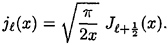
|
The more standard Bessel functions are given by the expansion
| (C.2) | 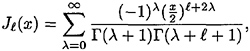
|
where ? refers to the factorial function ( Gamma function).
Using identities to relate ? functions of different argument, it can be shown that the series obtained by substituting Eq. (C.2) into Eq. (C.1) can be identified with expansions of simple periodic functions. In particular, it follows that some of the lowest order spherical Bessel functions can be written as
| (C.3) | 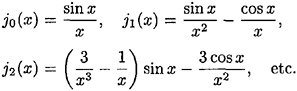
|
All the j ?( x) are well behaved near x=0. In fact, all but the ?=0 function vanish at the origin, and j 0(0)=1. The solutions of the radial Schr dinger equation that are singular at the origin are known as the Neumann functions, but such functions are not normalizable and therefore do not correspond to physical solutions for bound quantum mechanical systems. They are, however, important in the study of problems that exclude the origin, e.g., in the study of scattering.
Copyright World Scientific Publishing Co. Pte. Ltd. 2003 under license agreement with Books24x7


 TABLE OF CONTENTS