1.6 Relativistic Variables
In the Appendix we review the basics of special relativity, and use those results here to discuss briefly the kinematics in terms of relativistic variables. In the scattering of any two particles with rest masses m 1 and m 2, the velocity of the center-of-mass is obtained from the ratio of the total relativistic momentum and the total relativistic energy
| (1.56) | 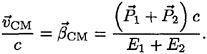
|
If m 1 refers to the mass of the projectile and m 2 to that of a target particle, then using laboratory variables, we obtain (with the target initially at rest)
| (1.57) | 
|
where our convention is to define  = P i for i=1, 2. At very low energies, namely when m 1 c 2 ? P 1 c, this reduces to our nonrelativistic expression of Eq. (1.47)
| (1.58) | 
|
At very high energies, when m 1 c 2 ? P 1 c and m 2 c 2 ? P 1 c, we can write the following for the value of ? CM
| (1.59) | 
|
When m 1 and m 2 are comparable, Eq. (1.59) simplifies to ? CM ? (  ), and, for this case,
  becomes
| (1.60) | 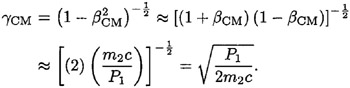
|
In general, we can obtain an expression for in the following way. We note from Eq. (1.57) that
| (1.61) | 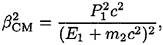
|
so that
| (1.62) | 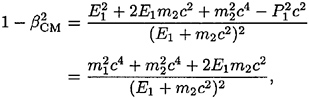
|
where we have substituted  for
for  . It therefore follows that
| (1.63) | 
|
which, in the high-energy limit of E 1 ?P 1 c


 TABLE OF CONTENTS