Essentially all of particle physics and many areas of nuclear physics deal with particles that travel at relativistic velocities, namely velocities that are close to the speed of light c. In this appendix we will therefore summarize some of the basic concepts and results of special relativity that are needed for interpreting relativistic processes.
Starting off with the assumption that the laws of physics do not depend on the relative motion of observers at rest in different inertial frames, and that the speed of light (in vacuum) is a constant of nature that is independent of the inertial frame, Albert Einstein showed that the space-time coordinates of an event observed in two such frames can be related through the Lorentz transformation. That is, for two inertial frames that move with a relative velocity ?= ? z= ?c with respect to each other, the relationship between the coordinates of any event in the two frames can be expressed as
| (A.1) | 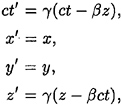
|
where we have chosen to define the z-axis as the direction of relative motion of our two coordinate frames (with primed and unprimed coordinates), and 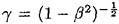 . The relations given in Eq. (A.1) can be written in the form of a matrix as
| (A.2) | 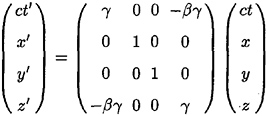
|
The inverse transformation involves just a change in the sign of v (and therefore of ?),
| (A.2?) | 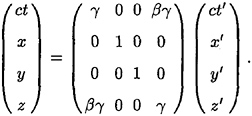
|
For a general Lorentz transformation, the matrix connecting the coordinates of the two reference frames is more complicated. But since we can always define...
Copyright World Scientific Publishing Co. Pte. Ltd. 2003 under license agreement with Books24x7


 TABLE OF CONTENTS