Introduction to Stochastic Calculus with Applications, Second Edition
Containing many solved examples and exercises, this book gives a simple but rigorous treatment of stochastic calculus and its applications, including a range of advanced topics.
 TABLE OF CONTENTS
 Stochastic calculus deals with functions of time t, 0 ? t ? T. In this chapter some concepts of the infinitesimal calculus used in the sequel are given.
A function g is called continuous at the point t = t 0 if the increment of g over small intervals is small,

If g is continuous at every point of its domain of definition, it is simply called continuous.
g is called differentiable at the point t = t 0 if at that point

this constant C is denoted by g ?( t 0). If g is differentiable at every point of its domain, it is called differentiable.
An important application of the derivative is a theorem on finite increments.
If f is continuous on [a, b] and has a derivative on (a, b), then there is c, a < c < b, such that

Clearly, differentiability implies continuity, but not the other way around, as continuity states that the increment ? g converges to zero together with ? t, whereas differentiability states that this convergence is at the same rate or faster.
The function g(t) = ?t is not differentiable at 0, as at this point
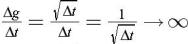
as t ? 0.
It is surprisingly difficult to construct an example of a continuous function which is not differentiable...