Introduction to Stochastic Calculus with Applications, Second Edition
Containing many solved examples and exercises, this book gives a simple but rigorous treatment of stochastic calculus and its applications, including a range of advanced topics.
 TABLE OF CONTENTS
 In this chapter we describe what happens to random variables and processes when the original probability measure is changed to an equivalent one. Change of measure for processes is done by using Girsanov's theorem.
We start with a simple example. Let ? = { ? 1, ? 2} with probability measure P given by p( ? 1) = p, p( ? 2) = 1 ? p.
Q is equivalent to P (Q ? P) if they have same null sets, i e. Q(A) = 0 if and only if P(A) = 0.
Let Q be a new probability measure equivalent to P. In this example, this means that Q( ? 1) > 0 and Q( ? 2) > 0 (or 0 < Q( ? 1) < 1). Put Q( ? 1) = q, 0 < q < 1.
Let now 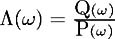 , that is,
 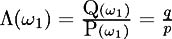 , and
, and 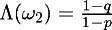 .
.
By definition of ? for all ?

Let now X be a random variable. The expectation of X under the probability P is given by

and under the probability Q

From (10.1)

Take X = 1, then

On the other hand, take any random variable ? > 0, such that E p( ?) = 1, and define Q by (10.1).
Then Q is a probability,...