Introduction to Stochastic Calculus with Applications, Second Edition
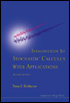
Containing many solved examples and exercises, this book gives a simple but rigorous treatment of stochastic calculus and its applications, including a range of advanced topics.
 TABLE OF CONTENTS
 Let X( t) be a semimartingale and f be a C 2 function. Then f( X( t)) is a semimartingale, and It 's formula holds

The quadratic variation [ X, X] jumps at the points of jumps of X and its jumps ?[ X,X]( s) = ( ? X( s)) 2. Thus the jump part of the integral ? t 0 f ?( X( s ?)) d[ X,X]( s) is given by ? s ? t f ?( X( s ?))( ? X( s)) 2, leading to an equivalent form of the formula

where [ X,X] c is the continuous component of the finite variation function [ X, X]. Using the relationship between the square and the sharp brackets (8.50), we can write It 's formula with the sharp bracket process of X, provided the sharp bracket exists,

where X cm denotes the continuous martingale part of X.
Let N( t) be a Poisson process. We calculate ? t 0 N( s ?) dN ( s). The answer can be derived from the integration by parts formula (8.24), but now we use (8.59). Since ( N( t) ? t) cm = 0 (by Corollary 8.30)

Since N( s) = N