An Introduction to the Basics of Reliability and Risk Analysis: Series in Quality, Reliability and Engineering Statistics, Vol. 13

We consider a system comprised of a set of N independent components, i = 1, 2, N , each of which has probability p i of being functioning and q i=1 - p i of being failed. Knowing the probability values p i i= 1, 2, N , and the system configuration, we wish to calculate the probability P that the system is functioning properly.
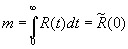
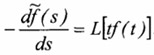
For time dependent situations we can calculate the reliability of the system R(t) as a function of the components' reliabilities R i( t), i=1,2, N [1], [2], [3], [4], [5]. In this case, we may also calculate the mean time to failure, m:
| (5.1) | |
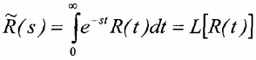
where
is the Laplace transform of R( t).
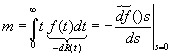
or
| (5.2) | |
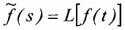
where
and
.
Consider the series system of Fig. 5.1. The logic of operation is that all components must function for the system to function.
In terms of the probability that the system functions (intersection of the events that all components function), we have:
| (5.3) | |
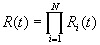
and of the system reliability,
| (5.4) | |
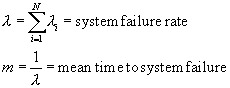
For exponential components, the system reliability becomes R ( t) = e -?t < R i ( t) =
, i.e. less than the reliability of the less reliable unit, with
| (5.5) | |
The series system is the only logic configuration in which components with constant...