9.4 Kaplan-Meier Estimator of the Survivor Function
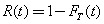
Let F T(t) denote the life distribution for a certain type of units. We know the distribution to be continuous, but make no further assumption about F T (t) , i.e. a non parametric model.
Let t j denote the observed lifetime of unit j. On the basis of the observed lifetimes of n units, j = 1, 2, , n we want to estimate the survival function,
Then, the empirical cumulative distribution function is (Figure 9.22)
| (9.64) | 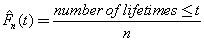
|
and the empirical reliability survival function (Figure 9.23)
| (9.65) | 
|
which is a step function decreasing by 1/n at each observed failure time.
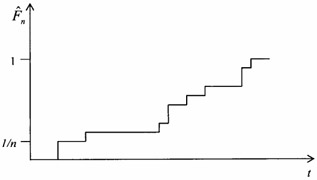 Figure 9.22: Empirical cumulative distribution function
 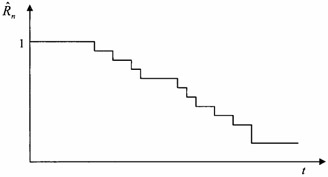 Figure 9.23: Empirical survival function
 The Kaplan-Meier estimator is regarded as the most direct nonparametric estimator of the survival function. It is the only coherent estimator of the survival function for censored tests [11].
The basic principle of the estimator is that being in good working condition after t means i) being so already before t and ii) not failing at t .
Let the time period [0, ?] be divided into small intervals ( u j, u j+1,] for j = 1, 2, , n, with u 0= 0 and the intervals short enough that we can disregard the possibility that two or more units fail or are censored in the same interval. Now let


 TABLE OF CONTENTS