An Introduction to the Basics of Reliability and Risk Analysis: Series in Quality, Reliability and Engineering Statistics, Vol. 13

Reliability and availability represent important performance parameters of a system, with respect to its ability to fulfil the required mission during a given functioning period [1], [2], [3], [4], [5]. From this point of view, two main types of systems can be defined:
Systems which must satisfy a specified mission within an assigned period of time: in this case, the reliability is the appropriate performance indicator of the ability to achieve the desired objective without failures;
Systems maintained: in this case, the availability quantifies in a suitable way the system ability to fulfill the assigned mission at any specific moment of its life time. Basic maintenance procedures can be distinguished in:
Off-schedule (corrective): this amounts to the replacement or repair of failed units;
Preventive: this amounts to performing regular inspections, and possibly repair, following a given maintenance plan;
Conditioned: it amounts to performing a repair action upon detection of degradation.
As above said, an important figure of merit for a system undergoing maintenance (i.e., corrective, preventive or conditioned maintenance) is its (un)availability [1], [2], [3], [4], [5].
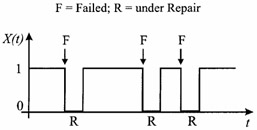
Let X(t) be an indicator variable denoting the state at time t of a system undergoing maintenance, such that (Fig. 6.1):
X(t)=1, system is operating at time t
X(t)=0, system is failed at time t
The instantaneous availability p(t) and unavailability q(t) are defined as the probability that the system is operating at time t