An Introduction to the Basics of Reliability and Risk Analysis: Series in Quality, Reliability and Engineering Statistics, Vol. 13

The prediction of reliability from failure statistics does not concern itself with what happens inside the unit, although it is intuitive that a unit fails when the stress imposed exceeds the strength. To properly describe such failure mechanism quantitatively, stress-strength models need to be introduced [13].
The stress on a unit is the total sum of internal (created by the operational use) and external stresses (imposed by the environmental conditions of use).
Obviously, the stress and strength operating on identical units are not fixed quantities and vary from unit to unit even if the best quality control procedures are used. Therefore, stress and strength should be considered as random variables. In the following, an outline is given of the basis for computing the component reliability from the knowledge of the distributions associated with these random variables.
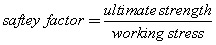
In the past, the concept of safety factors has been widely used in the design of engineering systems:
where the ultimate strength and the working stress are considered as fixed known values, with no consideration given to their variability.
To illustrate this concept, let us assume that the stress or load L applied to a component is normally distributed with density function f L( l) characterized by a mean ? L and a standard deviation ? L (Fig. 9.29). The strength of the unit has been determined to be S 1 : thus, the unit may fail only when the...