Multigroup Equations for the Description of the Particle Transport in Semiconductors

In this section, we introduce multigroup equations for investigating the transport of electrons and phonons at a heterojunction for the spatially homogeneous case, which means that f v and g do not depend on r . To begin with, we state the approximations used for describing the dispersion laws for the confined electrons and the 3D phonons. The electron energy E v( k ) in the in vth energy subband and the electron wave vector k are related by the spherical parabolic energy momentum rule (7.5). This implies that the modulus of the electron wave vector in the subband v is determined by
| (7.64) | |
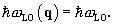
for the given energy E. Here, ? denotes the Heaviside step function. The energies of longitudinal optical (LO) phonons ? ? LO are related to the phonon wave vector q via the usual Einstein approximations (cf. Sec. 2.3)
| (7.65) | |
The electron system is described by a set of one-particle distributions functions f v( k , t), which gives the probability to find an electron in the infinitesimal volume d 2 k around k at time t in the the vth subband. The evolution equation for f v( k , t) is the 2D BTE (7.59a). By expressing k in polar coordinates
| (7.66) | |
with the polar angle ? between k