Multigroup Equations for the Description of the Particle Transport in Semiconductors

Chapter 9: Simulation of Silicon Devices

9.1 Introduction

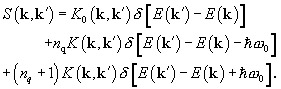
In this chapter we present numerical results obtained with the help of our multigroup WENO solver. All of the calculations are carried out for silicon at the temperature T L = 300 K. The conduction band of silicon is modeled by six equivalent energy valleys in the Kane approximation. Since we are modeling electrons moving in the same symmetry-type of valleys, the electron distribution function f represents an average probability function among these valleys. The collision term used includes acoustic deformation potential scattering and optical intervalley scattering between equivalent valleys. Therefore, the transition rate for the scattering of electrons in silicon reads

(9.1)
Table 9.1: Material parameters used for the simulation of silicon devices

Quantity

Symbol

Unit

Value

Mass density

?

kgm -3

2330

Effective mass ratio

m */ m 0

0.32

Non-parabolicity factor

? *

(eV) -1

0.5

Relative dielectric constant Si

? Si

11.7

Relative dielectric constant SiO 2

3.9

Optical phonon energy

? ? 0

eV

0.063

Intervalley coupling constant

D IV

10 10 eVm -1

11.4

Acoustic deformation potential

D A

eV

9

Sound velocity

? s

ms -1

9040

Lattice temperature

T L

K

300

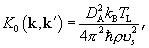
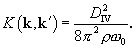
The symbols K 0( k, k') and K( k, k') are the acoustic deformation potential coupling constant and the intervalley coupling constant, respectively. According to the considerations in Sec. 2.4, they are given by

(9.2a)
(9.2b)

Further, the occupation number of the optical phonons n

UNLIMITED FREE
ACCESS
TO THE WORLD'S BEST IDEAS

SUBMIT
Already a GlobalSpec user? Log in.

This is embarrasing...

An error occurred while processing the form. Please try again in a few minutes.

Customize Your GlobalSpec Experience

Category: Piezoelectric Ceramics
Finish!
Privacy Policy

This is embarrasing...

An error occurred while processing the form. Please try again in a few minutes.