Practical Guide to Rotational Moulding

Chapter 2: Moulds

2.1 Introduction

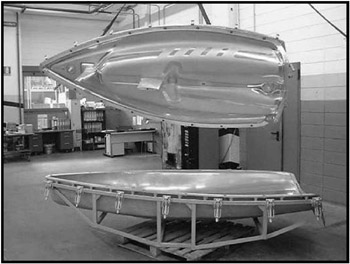
In the rotational moulding industry, the vast majority of moulds are made from metal - usually sheet steel, nickel or cast aluminium. The moulds are relatively thin, shell-like structures because the forces on the mould are small and it is desirable to transfer heat quickly to and from the mould. In most cases, the complexity and size of the part dictates the type of metal and method of manufacture used for the mould. For large parts with simple shapes, such as tanks, the moulds are normally fabricated from sheet metal - either carbon steel, stainless steel or aluminium. Cast aluminium is used for parts that are small to medium in size and have some degree of complexity. For highly detailed parts, such as doll heads, and where liquid vinyl is used to produce the moulded part, electroformed nickel is recommended. Examples of sheet metal and cast aluminium moulds are shown in Figures 2.1 and 2.2.


Figure 2.1: Sheet metal mould for a vertical tank

Figure 2.2: Cast aluminium mould
Courtesy of Persico SpA

2.2 Mould Materials

Many metals and many grades of metals are used in rotational moulding. Typical characteristics of mould materials are given in Table 2.1.

Table 2.1: Properties of common mould materials

Material

Thermal conductivity, K, W/m K (Btu/ft h F)

Specific heat capacity, C p J/kg K (Btu/lb F)

Aluminium (Duralumin)

147 (153)

917 (0.4)

Carbon steel (medium C)

51.9 (54)

486 (0.21)

Stainless steel (304)

UNLIMITED FREE
ACCESS
TO THE WORLD'S BEST IDEAS

SUBMIT
Already a GlobalSpec user? Log in.

This is embarrasing...

An error occurred while processing the form. Please try again in a few minutes.

Customize Your GlobalSpec Experience

Category: Carbon Steels and Alloy Steels
Finish!
Privacy Policy

This is embarrasing...

An error occurred while processing the form. Please try again in a few minutes.