SiC Materials and Devices, Volume 2

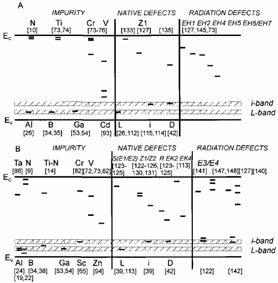
If the energies of the levels in the lower half of the band gap of 4H- and 6H-SiC (Table II and III) are compared, it will be noticed that most of the levels lie within two rather narrow bands in the band gap: E v+(0.5 0.6)eV ( i-band) and E v+0.2 0.3eV ( L-band) (Fig. 10). The first band contains the levels related to the D-and i-centers and a scandium level. A deep aluminum level, a gallium level, and a level related to the L-center lie within the second band. The boron level also lies inside ( 4H) or near the edge ( 6H) of the L-band. As the figure shows, the 4H- and 6H-SiC levels are distributed rather uniformly in the upper half of the band gap and it is impossible to distinguish any bands that coincide for both polytypes. Since the parameters of centers of the same type formed in the lower half of the band gap of different SiC polytypes are similar, it may be assumed that such bands are also present in other polytypes of silicon carbide. This conclusion is supported by the similarity of the characteristics and the shift, proportional to the band gap width, of the peaks of the main electroluminescence bands in various SiC polytypes (Fig. 6).