Smart Technologies
Providing a general introduction to intelligent or smart materials, systems and machines, this non-mathematical guide highlights the broad range of applications that can benefit from the concept.
 TABLE OF CONTENTS
 The second case study illustrates a number of different applications of computation. As in the first case, the area is damage detection. However, the discussion will focus not on the diagnostic, but on the optimisation of the sensor distribution feeding information to the diagnostic. The same methods serve to establish sensor networks which are failure-safe, i.e. still produce a diagnosis in the event of sensor failure. The system under investigation has been discussed in a number of previous works [33]; [34], it is a simple finite element (FE) model of a metal plate which loosely represents an aircraft skin panel. The dimensions of the plate were 300 300 3mm and the material constants of aluminium were used: density ? = 2700kgm ?3, Young's modulus E = 70 10 9Nm ?2 and Poisson's ratio ? = 0.3.
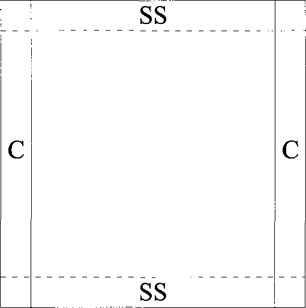
The boundary conditions assumed two clamped (CC) and two simplysupported (S) edges as shown in Fig. 4.14. The loading was combined bending and in-plane loading. The FE modelling of the plate was carried out using the ABAQUS software package and employed 900 eight-noded quadrilateral shell elements on a regular 30 30 mesh.
For the purposes of fault location, the plate was divided into thirty six regions (Fig. 4.15 shows the numbering of the regions). Damage was simulated simply by reducing the Young's modulus of a number of elements...