Smart Technologies
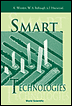
Providing a general introduction to intelligent or smart materials, systems and machines, this non-mathematical guide highlights the broad range of applications that can benefit from the concept.
 TABLE OF CONTENTS
 As described above, Rytter in [ [9]] distinguishes four levels of damage identification:
Level 1 (DETECTION) The method gives a qualitative indication that damage might be present in the structure.
Level 2 (LOCALIZATION) The method also gives information about the probable position of the damage.
Level 3 (ASSESSMENT) The method gives an estimate of the extent of the damage.
Level 4 (CONSEQUENCE) The method offers information about the safety of the structure, e.g. estimates a residual life.
The first case study presents a method for establishing a reliable level one diagnostic. The technique, novelty detection, is essentially an extension of classical condition monitoring where one continuously observes a system parameter and signals any significant change. The method differs in that new signal processing techniques allow the synthesis of effective parameters from almost any measured pattern.
The problem considered here is delamination detection in a composite plate and the data used to define the novelty measure are time records of the intensity of waves, Lamb waves [ ], travelling in the plate. The standard reference on the physics of Lamb waves is [19]. Lamb wave testing of composite plates has been discussed by numerous authors [20]; [21]; [22]; [23]; [24]; [25], describing the detection of various material failures including delaminations, fibre fracture and matrix cracking. One practical complication of Lamb wave inspection lies in the...