Notes on Acoustics

Written by a noted authority in the subject area, this book is a comprehensive study of the theory and practical application of acoustics to numerous fields.
 TABLE OF CONTENTS
 So far, we have dealt only with the kinematics of harmonic motion without regard to the forces involved. The real physics enters when we deal with the dynamics of the motion and it is now time to turn to it.
One reason for the unique importance of the harmonic motion is that in many cases in nature and in applications, a small displacement of a particle from its equilibrium position generally results in a restoring (reaction) force proportional to the displacement. If the particle is released from the displaced position, the only force acting on it in the absence of friction will be the restoring force and, as we shall see, the subsequent motion of the particle will be harmonic. The classical example is the mass-spring oscillator illustrated in Fig. 2.4. A particle of mass M on a table, assumed friction-less, is attached to one end of a spring which has its opposite end clamped. The displacement of the particle is denoted ?. Instead of sliding on the table, the particle can move up and down as it hangs from the free end of a vertical spring with the upper end of the spring held fixed, as shown.
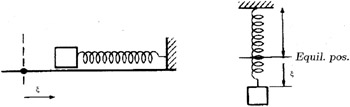
It is found experimentally that for sufficiently small displacements, the force required to change the length of the spring by an amount ? is K ?, where K is a constant. It is...