Notes on Acoustics
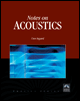
Written by a noted authority in the subject area, this book is a comprehensive study of the theory and practical application of acoustics to numerous fields.
 TABLE OF CONTENTS
 Many of the problems in acoustics of current interest were formulated and studied a long time ago, and atmospheric acoustics is a prime example. Systematic investigations of the acoustic transparency of the atmosphere can be traced back with certainty to the beginning of the 18th century. A report by Derham (1708) was an authoritative source for many years, but some of Derham s results and conclusions, particularly in regard to the influence of fog and rain on sound transmission, were challenged about 50 years later by Desor and were conclusively shown to be incorrect by John Tyndall, the prominent English scientist, who in 1874 directed an extensive experimental study of sound propagation. Unlike Derham, Tyndall found that fog, rain, hail, or snow did not cause any noticeable attenuation of sound, at least in the frequency range covered by the signaling devices involved in his experiments. Mounted 235 ft above high water on a cliff overlooking the ocean in the vicinity of Dover, England, several types of foghorns and cannons were used as sound sources. In Fig. 9.1 is reproduced a drawing of a steam-driven siren used in the experiments. Manufactured in the United States and furnished by the Washington Lighthouse Board, this particular sound source is a steam-driven siren with one fixed and one rotating disk with radial slots. The disks are mounted vertically across the throat of a conical horn, 16 1/2 feet long and 5 inches in diameter at the throat, gradually opening to reach a...