Notes on Acoustics

Written by a noted authority in the subject area, this book is a comprehensive study of the theory and practical application of acoustics to numerous fields.
 TABLE OF CONTENTS
 As we have seen, the linear oscillator is characterized by a restoring force proportional to the displacement. It was pointed out, however, that this linearity can be expected to hold only for small displacements from the equilibrium position. The deviation from linearity was illustrated qualitatively for both the coil spring and the air spring. A quantitative study of a nonlinear oscillator requires the solution of nonlinear differential equation which in most cases has to be done numerically, as illustrated in an example at the end of the chapter.
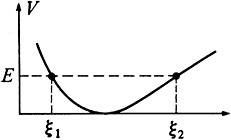
Some aspects of a nonlinear oscillator can be understood from the motion of a particle in a potential well, in which the potential energy of the particle is a known function of the displacement. (The mass-spring oscillator is a special case with the potential energy being proportional to the square of the displacement.)
We denote the potential energy of the particle by V( ?), where ? is the displacement in the x-direction from the stable equilibrium position at the bottom of the well ( ? = 0) where the potential energy is set equal to zero. As indicated in Fig. 2.8, the total energy of the particle is E. The kinetic energy is zero where E = V( ?); this determines the turning points ? 1 and ? 2 of the oscillator.