Notes on Acoustics

Written by a noted authority in the subject area, this book is a comprehensive study of the theory and practical application of acoustics to numerous fields.
 TABLE OF CONTENTS
 As already pointed out, the steady state motion in Eq. 2.33 was produced by a harmonic driving force F( t) = F cos( ?t) which is an idealization since it has no beginning and no end. We now turn to the response of the oscillator to a more general and realistic driving force.
We start by considering the motion of a damped mass-spring oscillator after it is set in motion by an impulse I at time t = t ?. We let the impulse have unit strength. Since the impulse is instantaneous, the displacement immediately after the impulse will be ? = 0 and the velocity,  = 1/ M. In the subsequent motion, the oscillator is free from external forces but influenced by a spring force and a resistive force ? Ru proportional to the velocity u. Then, for an underdamped oscillator, the displacement will be of the form given in Eq. 2.23, i.e.,

where ? = R/2 M , 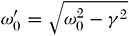 , and
, and  . As before, K is the spring constant. The amplitude A and the phase angle
  are determined by the displacement ? = 0 and the velocity = 1/ M at t = t ?.
In order to make the displacement zero at t = t ? we must have = ?/2 which means that the...