Area Array Packaging Handbook: Manufacturing and Assembly

Raza Ghaffarian
Jet Propulsion Laboratory
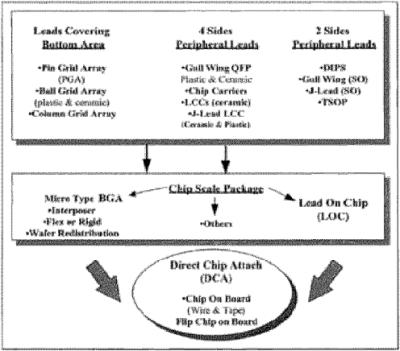
The dominant trend within electronics today is the drive toward increasingly smaller feature sizes on integrated circuit (IC) chips. Ten years ago, feature sizes of 1 m were the norm; by the mid-1990s, 0.35 m was the norm, and research and development ICs are at 0.25 m and under. This has led to a drastic increase in the number of input-outputs (I/Os) on the chip, particularly for application-specific ICs (ASICs). Indeed, 300 to 500 I/Os per chip are no longer uncommon, and now ASICs having up to and higher than 1000 I/Os are under development. Figure 20.1 shows different surface-mount components from plated through-hole (PHT) to chip scale packages (CSPs) in the trend toward miniaturization.
This great increase in I/Os pushes on the packaging engineer to arrive at a suitable way of interconnecting the IC to a printed wiring board (PWB) or to a ceramic substrate. Mounting on an organic substrate, typically referred to as a PWB, is much less expensive than mounting on a ceramic substrate. Concomitant with the increase in I/Os, or pins, is the drive to achieve higher component densities, thereby increasing board functionality. The current trend in electronic packaging is
Increasing pin count
Increasing component density (more functionality per unit area)
Lighter weight
Several different approaches are being employed to meet the challenge of mounting high-pin-count ICs to substrates and packages on PWBs. These approaches can be considered a...