Building the Power-Efficient PC: A Developer's Guide to ACPI Power Management

This book provides developers and integrators with practical knowledge and design techniques for building PCs that address the increasing demand for energy conservation.
 TABLE OF CONTENTS
 In the early days of personal computing, under the DOS and CP/M operating systems, there was no power management computers either used 100 percent of their power requirements or were switched off. Personal computer power management history dates back at least to1989, when Intel shipped processors with technology to allow the CPU to slow down, suspend, or shut down part or all of the system platform, or even the CPU itself, to preserve and extend battery life. The increasing importance of power management reflects the increasing number of PCs in use and their transition to tools that go wherever people go.
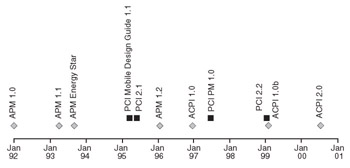
Three interlocked tracks guided the development of PC power management one for power management specifications, one for system design specifications, and one for application specifications. Figure 2.1 shows the timeline for key power management and system design specifications; application program power management specifications are defined by the underlying ACPI operating system. You ll learn later in this chapter how problems in early power management technology, particularly the Advanced Power Management (APM) Specification, directly influenced the design of the Peripheral Component Interconnect (PCI) and ACPI specifications.
Mobile computers started the drive for PC power management. Early attempts, including the Osborne computer and luggable PCs with cathode ray tubes, drew so much power they had no alternative but to plug into external power sources. The development of low cost, reliable liquid crystal displays (LCDs) made battery powered laptops possible in the...