Building the Power-Efficient PC: A Developer's Guide to ACPI Power Management

This book provides developers and integrators with practical knowledge and design techniques for building PCs that address the increasing demand for energy conservation.
 TABLE OF CONTENTS
 Power management is more complex than most other aspects of PC design, because it involves connections among PC components that interact in many different ways. The electronics directly consume power, interacting with the power supply, and generate heat, interacting with the device packaging, cooling, and thermal management components. The electronics are partitioned into subsystems, each of which may maintain (or require the system to maintain) context information as they move from one power management state to another. The interactions are complex enough that they must be controlled by software, which introduces complexities of its own. The subsystems are not interconnected randomly; they often have well-defined buses with unique functions, rules, and constraints.
This chapter discusses each of those topics, introducing the key technical concepts underlying power management.
Electric room heaters are a perfect example of how electronic components consume power and dissipate heat. In a room heater, power flows from the input lines across a resistance, where it s consumed and turned into heat.
The electronics in a computer work the same way. In Figure 3.1 you see a power source feeding a resistive load. The power source applies voltage V across the load, which has resistance R.
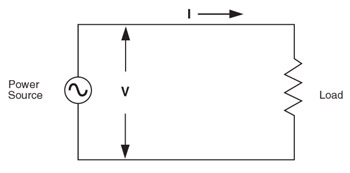
Ohm s law says the direct current (DC) I through the load will be
I = V / R
We can also calculate the power dissipation W:
W = V * I = V <sup2 </sup>/ R
From that last result, you know...