Building the Power-Efficient PC: A Developer's Guide to ACPI Power Management

This book provides developers and integrators with practical knowledge and design techniques for building PCs that address the increasing demand for energy conservation.
 TABLE OF CONTENTS
 An ACPI BIOS provides the tables and AML routines required by the operating system to describe resources on the motherboard, and supports power management-related processing prior to activation of the ACPI operating system. Support for entry into and exit from the S3 sleep state characterizes the processing responsibilities of the BIOS.
ACPI uses tables to describe system information, features, and control methods, giving hardware vendors great implementation flexibility. The ACPI tables list devices on the system board, or devices that cannot be detected or power managed using some other hardware standard, plus their capabilities. The tables describe system capabilities such as the sleeping power states supported, the power planes and clock sources available in the system, batteries, system indicator lights, and other motherboard resources. That collection of information enables the operating system ACPI driver to control system devices without needing to know how the system controls are actually implemented.
The Root System Description Table (RSDT) is the directory to all the other description tables, providing the operating system access to all the available ACPI data (see Figure 7.1). The OS finds the RSDT through the Root System Description Pointer structure located in system memory and set up by the BIOS.
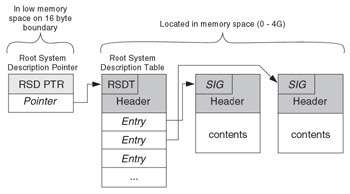
One of the key elements in the RSDT is a pointer to the Fixed ACPI Description Table (FADT). [1] Data in the FADT includes fixed-length entries describing the fixed ACPI features of the...