CAM Design Handbook

Emphasizing computer-aided design and manufacturing techniques, as well as sophisticated numerical control methods, this book allows engineers and technicians to utilize cutting edge design tools.
 TABLE OF CONTENTS
 Dimitri Elgin
D. Elgin Cams
Redwood City, Calif.
www.elgincams.com
It is established that the automotive camshaft is the most influential component that governs how the engine can perform. The choice of camshaft (cam shape) has a responsibility, reliability, and durability as well as a performance impact.
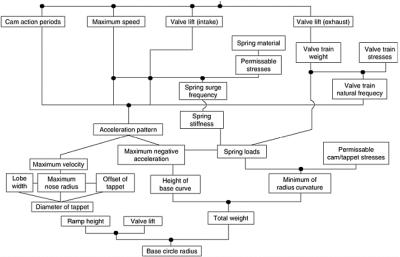
Before designing the cam lobes (intake and exhaust) one must consider what the engine wants for a timing event diagram seat-to-seat timing. One must address the physical limitations such as piston to valve clearance, valve-to-valve clearance, follower constraints, and spring limitations. There are at least 25 items to consider in designing the actual cam lobe (Fig. 16.1).
The writer has had the distinct advantage of having worked with two of the pioneers on the subject of automotive valve cams, Ed Winfield and Cliff Collins. These men modified the primitive circular arc and tangent cam profiles by adding ramps and reducing jerk. In addition they were aware of the demand for air and fuel in the engine and maximized the area of the displacement the curve at the valve to maximize the flow of all gases. Another development was the effective performance of the valve spring. Valve springs were always the limiting factor as to how much valve acceleration could be applied (positive and negative). Custom racing valve springs of silicon chrome wire were initiated as an improvement of the engine performance over its range of speeds.
With the advent of the computer...