Clean Energy

Presenting a broad survey of the energy problems facing society over the coming decades and the prospects for their solution, this book emphasizes the importance of developing a strategy for the world's future energy supply.
 TABLE OF CONTENTS
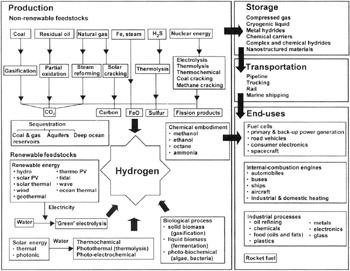
 Hydrogen, the most common element on earth, is widely seen as the ultimate form of Clean Energy and, as such, merits a chapter of its own. The proposition that hydrogen should be a sustainable medium of energy has become known as the 'Hydrogen Economy'. This term is thought to have been coined in 1970 by Neil Triner at the General Motors Technical Laboratory in Warren, USA. [1] The overall scheme of the Hydrogen Economy is illustrated conceptually in Figure 8.1, which outlines the many different possible routes to hydrogen from both conventional and novel primary energy sources, the storage and transportation modes for hydrogen, and its end-uses in fuel cells, engines, and industrial processes. This is a broad canvas and many authors restrict the use of the term Hydrogen Economy (or 'Hydrogen Energy') to the production of hydrogen from non-fossil sources, its distribution and storage, and its combustion in a fuel cell to generate electricity.
Hydrogen has many potential attractions as a new fuel. It may be derived from non-fossil sources, it burns cleanly to water with no pollutants being emitted, it is suitable for use in a fuel cell to generate electricity directly, and it has a high energy content expressed on a per mass basis (see Table 2.1, Chapter 2). Unfortunately, these attractive features are counter-balanced by many practical engineering and economic...