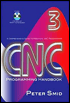
CNC Programming Handbook: A Comprehensive Guide to Practical CNC Programming, Third Edition
Typical CNC program is composed of series of sequential instructions related to machining a part. Each instruction is specified in a format the CNC system can accept, interpret and process. Each instruction must also conform to machine tool specifications. This program input method can be defined as an arrangement of machining instructions and related tasks, written in the format of a CNC system and aimed at a particular machine tool.
Various controls may have different formats, but most are similar. Subtle differences exist among CNC machines from different manufacturers, even those equipped with the same control system. This is common, considering the specific demands individual machine builders place upon the control manufacturer to accommodate many original and unique machine design features. Such variations are usually minor but still important for programming.
The field of CNC has its own terminology, special terms and its jargon. It has its own abbreviations and expressions that only people in the field understand. CNC programming is only a small section of computerized machining and it has a number of its own expressions. The majority of them relate to the structure of part programs.
There are four basic terms used in CNC programming. They appear in professional articles, books, papers, lectures and so on. These words are the key to understanding general CNC terminology:
Each term is very common and equally important in CNC programming and deserves its own detailed explanation.
A character is the smallest unit of...