CNC Programming Handbook: A Comprehensive Guide to Practical CNC Programming, Third Edition

In a single setup, CNC lathes can produce very high quality threads, in addition to turning, boring, grooving and other operations. This is a very attractive feature for manufacturers and many machine shops have purchased a CNC lathe for that reason alone. Any secondary operation requires additional setup, increasing the cost of production.
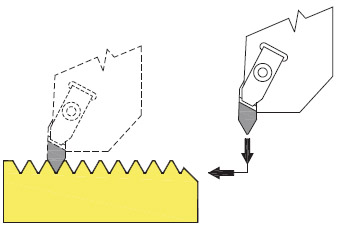
Single point thread cutting - typically known as a single point threading - uses a tool holder similar to other tool holders, but contains a special threading indexable insert, which may have one, two or three tips. Generally, the threading insert shape and size must match the shape and size of finished thread - Figure 38-1.
By definition, standard single point threading is a unique machining process of cutting a helical groove of a specific shape with uniform advancement per spindle revolution. The thread shape - or form - is mainly determined by the shape and mounting position of cutting tool. The uniformity of advancement is set by programmed feedrate.
The most common thread form used in CNC programming is the familiar V-thread (in the shape of letter V) with a 60 included angle. There is a large variety of V-shape thread forms used in manufacturing, including metric and imperial threads. Other forms include trapezoidal shapes, such as metric trapezoid, Acme and worm threads, square and round threads, buttress threads and many others. In...