Computational Models for Turbulent Reacting Flows

The simplest closure for the chemical source term is to assume that the joint composition PDF can be represented by its moments. In general, this assumption is of limited validity. Nevertheless, in this section we review methods based on moment closures in order to illustrate their limitations.
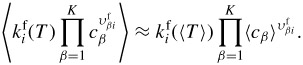
The limiting case where the chemical time scales are all large compared with the mixing time scale ? ?, i.e., the slow-chemistry limit, can be treated by a simple first-order moment closure. In this limit, micromixing is fast enough that the composition variables can be approximated by their mean values (i.e., the first-order moments ? ? ?). We can then write, for example,
| (5.52) | ![]() |
Or, to put it another way, the simplest first-order moment closure is to assume that all scalar covariances are zero:
| (5.53) | |
so that ? S( ?) ? = S( ? ?) ?.
In most commercial CFD codes, (5.52) is the 'default' closure that is employed for modeling reacting flows. However, if any of the chemical time scales are small compared with the mixing time scale, this approximation will yield poor predictions and may lead to poor convergence! Physically, when the chemical time scales are small relative to the mixing time scale, the chemical reactions will be limited by sub-grid-scale mixing. The composition covariances (i.e., the second-order moments) will then be equal in magnitude to the first-order moments. This fact is most easily demonstrated for the...