Computational Models for Turbulent Reacting Flows

The methods developed thus far in this chapter apply to arbitrary chemical kinetic expressions. However, in the case of 'simple' chemistry (defined below), it is possible to work out the relationship between the original and transformed scalars analytically without using (numerical) SVD. Thus, in this section, we develop analytical expressions for three common examples of simple chemistry: one-step reaction, competitive-consecutive reactions, and parallel reactions. Before doing so, however, we will introduce the general formulation for treating simple chemistry in terms of reaction-progress variables.
Chemical reactions for which the rank of the reaction coefficient matrix ? is equal to the number of reaction rate functions R i ( i ? 1, , I) (i.e., N ? = I), can be expressed in terms of I reaction-progress variables Y i ( i ? 1, , I), in addition to the mixture-fraction vector ?. For these reactions, the chemical source terms for the reaction-progress variables can be found without resorting to SVD of ?. Thus, in this sense, such chemical reactions are 'simple' compared with the general case presented in Section 5.1.
In order to simplify the discussion further, we will only consider the case where the molecular diffusivities of all chemical species are identical. We can then write the linear accumulation and transport terms as a linear operator:
| (5.158) | ![]() |
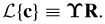
so that the scalar transport equation becomes
| (5.159) | |
The dimensionless vector...