B.1 Quadrature Method of Moments
The quadrature method of moments (QMOM) is apresumed PDF approach that determines the unknown parameters by forcing the lower-order moments of the presumed PDF to agree with the moment transport equations (McGraw 1997; Barrett and Webb 1998; Marchisio et al. 2003a; Marchisio et al. 2003b). As with the multi-environment presumed PDF method discussed in Section 5.10, the form of the presumed PDF is
| (B.1) |  |
where N s = K + 1 is the number of scalars in the composition vector ?. However, unlike with the multi-environment model, the probabilities p n and conditional means ? ? ? ? n are found by forcing (B.1) to yield known values for the moments:
| (B.2) |  |
where the m i are typically chosen to be non-negative integers.
As an example, consider a uni-variate case ( N s = 1) where
| (B.3) |  |
The right-hand side of this equation involves 2N e unknowns: ( p 1,..., p Ne) and ( ? ? ? 1,..., ? ? ? N e). In the QMOM approach, these unknowns can be found from a unique set of 2 N e moments. For example, integer moments with m = 0, 1,..., 2 N e 1 can be employed:
| (B.4) | 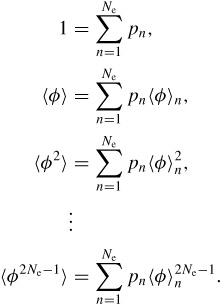 |
The modeling problem then reduces to finding ( p 1 ,..., p Ne) and ( ? ? ? 1,..., ? ? ? N e) assuming the left-hand...


 TABLE OF CONTENTS