Computational Models for Turbulent Reacting Flows

For elementary chemical reactions, it is sometimes possible to assume that all chemical species reach their chemical-equilibrium values much faster than the characteristic time scales of the flow. Thus, in this section, we discuss how the description of a turbulent reacting flow can be greatly simplified in the equilibrium-chemistry limit by reformulating the problem in terms of the mixture-fraction vector.
Having demonstrated the existence of a mixture-fraction vector for certain turbulent reacting flows, we can now turn to the question of how to treat the reacting scalars in the equilibrium-chemistry limit for such flows. Applying the linear transformation given in (5.107), the reaction-progress-vector transport equation becomes
| (5.148) | ![]() |
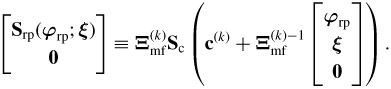
where the vector function S rp( ? rp; ?) contains the first N ? components of the transformed chemical source term: [83]
| (5.149) | ![]() |
Note that, given ? rp and ?, the inverse transformation, (5.109), can be employed to find the original composition vector c. In order to simplify the notation, we will develop the theory in terms of ? rp. However, it could just as easily be rewritten in terms of c using the inverse transformation.
The N ? eigenvalues of the Jacobian of S rp will be equal to the N ? non-zero eigenvalues of the Jacobian of S c. Thus, in the equilibrium-chemistry limit, the chemical time scales will obey
| (5.150) | |
where ? ? is the characteristic scalar-mixing...