CMOS RFIC Design Principles
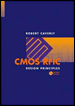
Including numerous examples that clearly illustrate and support important topics, this book provides a practical resource for comprehensive, expert guidance on designing CMOS RF integrated circuits.
 TABLE OF CONTENTS
 Oscillators are used in a many of the blocks in an RFIC. In the receive section, oscillators are used in conjunction with mixers for frequency shifting (primarily by downconversion) of the received RF signal to a lower frequency so that signal processing can be more easily performed. On the transmit side, the oscillator generates a signal that is encoded with the information to transmit and then frequency shifted (primarily upconverted), amplified, and sent to the antenna for transmission.
"Why can a high school kid running a PA system make an oscillator, but a pro-fessor with Lyapanov [1] functions and ADS cannot?" [1]. While a humorous quote to be sure, the quote really gets to the crux of the oscillator design problem. Although an amplifying structure is indeed required to create an oscillator (the PA system), a host of other issues arise as part of the oscillator design:
The oscillator frequency should be controllable.
The oscillator signal amplitude should be controllable.
The oscillator should have reasonable power consumption.
The oscillator should be stable and controllable.
The oscillator signal should not cause undue interference with adjacent signals.
We need to know how on-chip components influence the design and operation of oscillators.
These and other oscillator issues are discussed in this chapter. The chapter begins with a review of general feedback principles (no Lyapunov functions seen here, but we do discuss the Barkhausen [2] criteria). With these general feedback principles, the design of fixed-frequency oscillators is covered from several complementary...