CMOS RFIC Design Principles
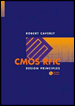
Including numerous examples that clearly illustrate and support important topics, this book provides a practical resource for comprehensive, expert guidance on designing CMOS RF integrated circuits.
 TABLE OF CONTENTS
 As discussed in detail in Chapter 1 on communication link budgets, the RF power at the receiver terminals is a direct function of the transmitted power. The previous chapters have discussed many on-chip, low-power circuits that allow the generation or detection of wireless communications signals. These low-level signals must be amplified significantly before they are sent to the antenna for transmission. These power amplifiers must exhibit decent gain and be able to drive the impedance of an externally connected antenna (usually 50 ?). The PAs must also be thrifty with their power consumption, and convert as much of the dc power drawn into usable RF energy (i.e., efficiency). Depending on the transmitted modulation scheme, the amplifiers should exhibit good linearity to prevent odd-order distortion components from broadening the spectral width of the signal (so-called spectral regrowth). With the relatively low transconductance of CMOSs, physically large MOSFETs must be constructed with the accompanying large parasitic capacitance values and so the frequency response of the amplifiers becomes a concern.
This chapter presents a review of traditional power amplifiers, which are further divided into so-called transconductance amplifiers (Class A through C) and high-efficiency amplifiers (Classes E and F, with little mention of Class D).
A large number of design techniques have been advanced over the years for amplifier designs using discrete amplifying devices. The primary design techniques are based on measured S-parameter data available from the manufacturer, measured under specific bias conditions,...