Dean's Analytical Chemistry Handbook, Second Edition

Energy can be transmitted by electromagnetic waves. They are characterized by their frequency v, the number of waves passing a fixed point per second, and their wavelength ?, which is the distance between the peaks of any two consecutive waves. As the frequency increases, the wavelength decreases and, conversely, as the frequency decreases, the wavelength increases.
In any electromagnetic wave, wavelength and frequency are related to the energy of a photon, E, by Planck s constant h (6.62 10 ?34 J s) and c (2.998 10 10 cm s ?1), the velocity of radiant energy in a vacuum:
| (6.1) | |
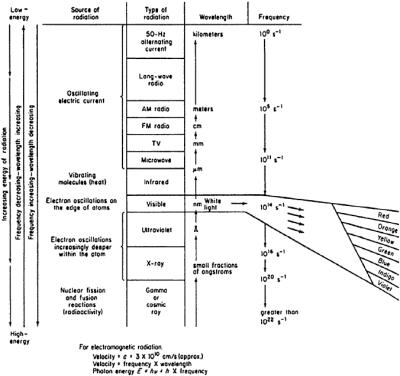
The values of the wavelength and frequency differentiate one kind of radiation from another within the electromagnetic spectrum, the name given to the broad range of radiations that extend from cosmic rays with wavelengths as short as 10 ?9 nm all the way up to radio waves longer than 1000 km. The various regions in the electromagnetic spectrum are displayed in Fig. 6.1 along with the nature of the changes brought about by the interaction of matter and radiation.
Wavelengths are expressed in different units throughout the electromagnetic spectrum. This may lead to confusion and error when attempting to determine equivalent values, or when reading older literature that used values different from the International Union of Pure and Applied Chemistry (IUPAC) recommendations. Table 6.1 contains the symbols, SI...