Dean's Analytical Chemistry Handbook, Second Edition

Section 14: ELECTROANALYTICAL METHODS

14.1 ELECTRODE POTENTIALS

14.1.1 Introduction

Many chemical reactions can be classified as oxidationreduction reactions (redox reactions) and can be considered as the resultant of two reactions, one oxidation and the other reduction. An element is said to have undergone oxidation if it loses electrons or if its oxidation state has increased, that is, it has attained a more positive charge. An element is said to have undergone reduction if it gains electrons or if its oxidation state has been reduced, that is, it has attained a more negative charge. Atoms of elements in their elemental state have a zero charge.

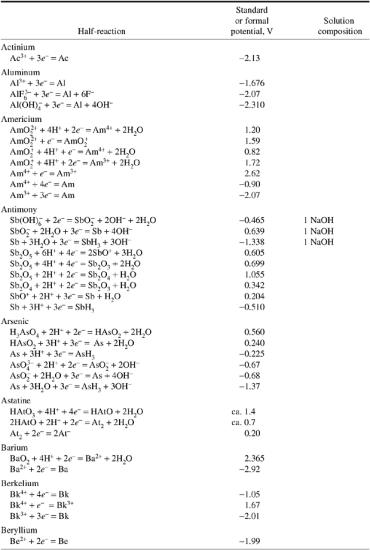
Table 14.1 reflects the relative affinity for electrons between an element and its ion or between two intermediate oxidation states of an element. The values given in Table 14.1 are reduction potentials, where E 0 is the single electrode potential when each substance involved in the oxidationreduction reaction is at unit activity. If a particular substance is more easily oxidized than hydrogen, its E 0 is assigned a negative value. If a substance is not oxidized as easily as hydrogen, its E 0 is positive in sign.

Standard potentials are tabulated except when a solution composition is stated; the latter are formal potentials and the concentrations are in mol/liter.

Table 14.1: Potentials of the Elements and Their Compounds at 25 C

14.1.2 Standard and Formal Potentials

The potentials listed in Table 14.1 are given in volts versus the normal hydrogen electrode. Standard potentials are denoted by the...

UNLIMITED FREE
ACCESS
TO THE WORLD'S BEST IDEAS

SUBMIT
Already a GlobalSpec user? Log in.

This is embarrasing...

An error occurred while processing the form. Please try again in a few minutes.

Customize Your GlobalSpec Experience

Category: Oxidation Reduction Potential (ORP) Instruments
Finish!
Privacy Policy

This is embarrasing...

An error occurred while processing the form. Please try again in a few minutes.