Dean's Analytical Chemistry Handbook, Second Edition

Mass spectrometry is the analytical technique that provides the most structural information for the least amount of analyte material. It provides qualitative and quantitative information about the atomic and molecular composition of inorganic and organic materials and their chemical structures. As an analytical technique it possesses distinct advantages:
Increased sensitivity over most other analytical techniques because the analyzer, as a mass-charge filter, reduces background interference.
Excellent specificity from characteristic fragmentation patterns to identify unknowns or confirm the presence of suspected compounds.
Information about molecular weight.
Information about the isotopic abundance of elements.
Mass spectrometry often fails to distinguish between optical and geometrical isomers and the positions of substituent in o-, m- and p-positions in an aromatic ring. Also, its scope is limited in identifying hydrocarbons that produce similar fragmented ions.
Application of mass spectrometry for the analysis of pesticides and herbicides is discussed in Sec. 20 and in the environmental analysis of trace organic pollutants is highlighted in Sec. 21.
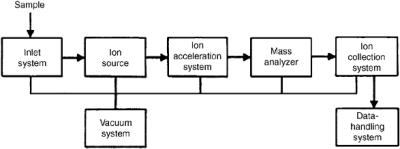
Functionally, all mass spectrometers have these components (Fig. 10.1): (1) inlet sample system, (2) ion source, (3) ion acceleration system, (4) mass (ion) analyzer, (5) ion-collection system, usually an electron multiplier detector, (6) data-handling system, and (7) vacuum system connected to components (1) through (5). To provide a collision-free path for ions once they are formed, the pressure in the spectrometer must be less than 10 6 torr.