Dean's Analytical Chemistry Handbook, Second Edition

As a class, unsaturated compounds represent the majority of organic structures, particularly if structures containing other functional groups are included. The analytical methods outlined in Tables 19.1 and 19.2 and elsewhere in this section are generally useful for compounds containing carbon-to-carbon unsaturated hydrocarbon compounds. They may or may not apply to structures containing other functional groups. In some cases, either chemical or instrumental methods will be applicable; the analyst may then choose a method compatible with the circumstances.
| |
| |
| |
| |
| |
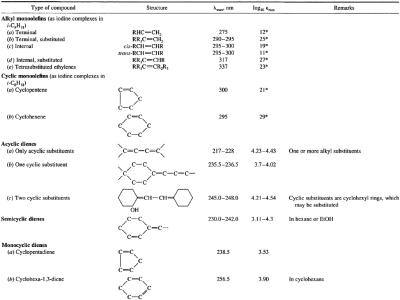
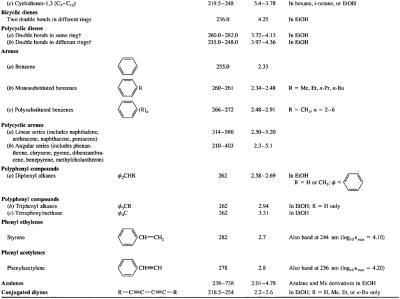
| *Apparent molecular absorptivity (not its logarithm) in liters per mole of olefins per gram per liter of I 2 for a 1-cm path length. Steroid and triterpenoid dienes. Source: L. Meites, ed., Handbook of Analytical Chemistry, McGraw-Hill, New York, 1963. |
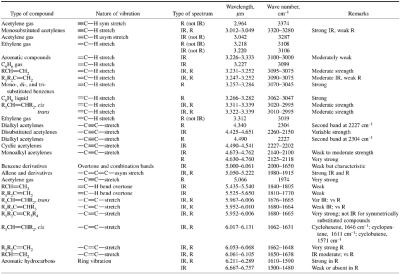
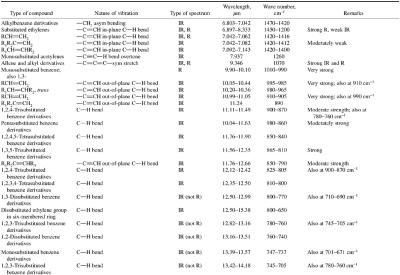
Infrared and Raman absorption bands are useful for the identification of compounds containing carbon carbon double or triple bonds. Table 19.1 lists the characteristic wavelengths associated with stretching or deformation vibrations in various unsaturated structures. Before applying these correlations to analytical problems, it will usually be desirable to consult sources of more detailed spectral data. Pertinent information is contained in Sec. 7 on infrared absorption, Raman frequencies, and spectra structure correlation charts.
The bands listed in Table 19.1 are arranged in order of increasing wavelength (in the fourth column) or decreasing frequency (in the fifth column). The first column...