The analysis of variance (ANOVA) is one of the most widely used techniques in applied statistics. It plays a central role in the analysis of gauge R&R studies. The objective of this appendix is to give an elementary description of the mechanics and underlying distribution theory of the ANOVA.
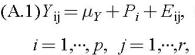
Suppose we have p different levels of a single factor that we wish to compare. These different factor levels are sometimes called treatments. Each treatment is replicated r times. The observed response from each of the p treatments is a random variable. The data usually appear as in Table A.1. An entry in this table ( Y ij) represents the jth observation taken under the ith treatment. In a gauge R&R study, the observations are measurements on the p parts. The model for the data in Table A.1 was presented in Equation (2.1) as
where ? Y is a constant, P i is a random variable that represents the parts, and E ij is a random error term. The P i are often called the treatment effects. We assume that P i and E ij are jointly independent normal random variables with means of zero and variances  and
and  , respectively.
Table A.1: Data for a one-factor ANOVA. | Treatment | Observations | Totals | Averages |
| 1 | Y 11 | Y 12 | | Y 1 r | Y 1* |  |
| 2 | Y 21 | Y 22 | | Y 2 r |
Copyright The American Statistical Association and the Society for Industrial and Applied 2005 under license agreement with Books24x7

 TABLE OF CONTENTS