Design and Analysis of Gauge R&R Studies: Making Decisions with Confidence Intervals in Random and Mixed ANOVA Models
In this appendix we describe the rationale for the MLS and GCI approaches. We do this in the context of a balanced random model with the ANOVA shown in Table B.1. Given the standard normality and independence assumptions made in this book,
are jointly independent chi-squared random variables with n q degrees of freedom.
| Source of variation | Degrees of freedom | Mean square | Expected mean square |
|---|---|---|---|
| Factor 1 | n1 | | ? 1 |
| Factor 2 | n 2 | | ? 2 |
| | | | |
| Replicates | n Q | | ? Q |
The term modified large-sample was introduced by Graybill and Wang [25] in their paper proposing a confidence interval for nonnegative linear combinations of variance components. To apply this method, one starts with an approximate large-sample confidence interval. The interval is then modified to make it exact under certain parameter conditions. To demonstrate, consider the problem of constructing a confidence interval for ? = ? 1 + ? 2, where ? 1 and ? 2 are defined in Table B.1. The uniformly minimum variance unbiased estimator for ? is
and this estimator has variance
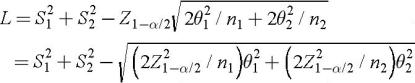
. Thus, the 100 (1 ? ?)% large-sample confidence interval for ? is
and
where Z 1? ?/ 2 is the percentile from a standard normal distribution with area 1 ? ?/2 to the left. We now replace