Desktop Encyclopedia of Telecommunications, Second Edition

Explanations, not just definitions.
 TABLE OF CONTENTS
 The increasing popularity of the Internet has awakened companies to the numerous commercial opportunities that involve the sale of goods and services to a vast, global marketplace. According to various industry estimates, about 50,000 merchants have set up shop on the Web as of year-end 1999. More businesses are also engaged in e-commerce with each other. The investment firm Goldman Sachs estimates that the value of business-to-business e-commerce conducted in the United States will be approximately $1.5 trillion by 2004, up from an estimated $114 billion in 1999. Better security, simplified payment systems, and easy-to-use e-commerce development tools have contributed to the success of e-commerce in recent years.
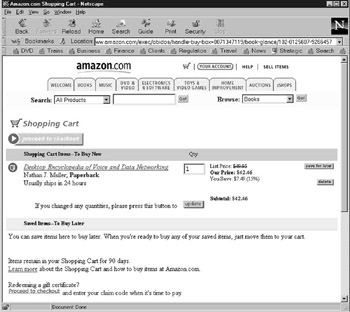
A number of tools are available for creating and managing secure electronic payment systems. Such tools typically offer a shopping cart that can be accessed by a Web browser (refer to Figure E-1). With these tools, retail merchants of any size can set up and manage virtual storefronts on the Internet with templates that are included in the software. With the storefront in place, companies can then process credit card payments over the Internet. The application takes payment information from Internet clients who are protected by 128-bit Secure Sockets Layer (SSL) encryption. This system also enables retailers to add product-related searching, sales tax and audit reports, and discounts and coupons.