Desktop Encyclopedia of Telecommunications, Second Edition

Explanations, not just definitions.
 TABLE OF CONTENTS
 Gateways interconnect dissimilar networks or applications and operate at the highest layer of the Open Systems Interconnection (OSI) reference model: the application layer (refer to Figure G-1). A gateway consists of protocol-conversion software that usually resides in a server, minicomputer, mainframe, or front-end device. One application of gateways is interconnecting disparate networks or media by processing the various protocols that each network uses, so that information from the sender is intelligible to the receiver (despite differences in network protocols or computing platforms).
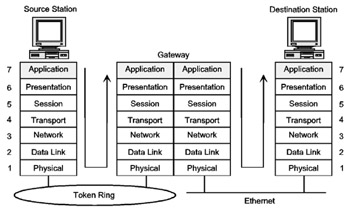
For example, when you use an SNA gateway to connect an asynchronous PC to a synchronous IBM SNA mainframe, the gateway acts as both a conduit through which the computers communicate and as a translator between the various protocol layers. The translation process consumes considerable processing power, resulting in relatively slow transmission rates when compared to other interconnection methods (hundreds of packets per second for a gateway, versus tens of thousands of packets per second for a bridge).
In addition to its translation capabilities, a gateway can check on the various protocols that are in use, ensuring that there is enough protocol processing power available for any given application. A gateway also helps ensure that the network links maintain a level of reliability for handling applications in conformance with predefined error-rate thresholds.
Gateways have a variety of applications. In addition to facilitating LAN workstation connections to various host environments, such as IBM s SNA...