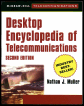
Desktop Encyclopedia of Telecommunications, Second Edition
Explanations, not just definitions.
 TABLE OF CONTENTS
 Wavelength-Division Multiplexing (WDM) technology has been in use by long-distance carriers in recent years to expand the capacity of their trunks by enabling a greater number of signals to be carried on a single fiber. Although the technology has been in existence since the late 1980s, the need among carriers to obtain more performance and flexibility from their fiber-optic networks only arose in the mid-1990s. AT&T, Sprint, and MCI WorldCom (among others) have made long-term commitments to WDM technology and will be using it to ramp up their trunk speeds from 2.5Gbps to more than 40Gbps (without having to install additional fiber).
WDM will help eliminate capacity constraints in carrier networks that are brought on by the ever-increasing processing power of computers and the need to link multiple users at multiple locations. WDM supports applications such as the simultaneous distribution of full-motion video and medical images, without forcing carriers to install new fiber backbones.
WDM works with a variety of existing protocols and technologies, such as Synchronous Optical Network (SONET) services ranging from OC-1 (51.8Mbps) to OC-256 (13.271Gbps) and broad-band Asynchronous Transfer Mode (ATM) cell switching.
A relatively new trend in fiber networks is the adaptation and deployment of WDM systems in enterprise networks. Enterprise data communication requirements for greater network bandwidth, lower cost, and absolute reliability are being driven by applications such as data mirroring and vaulting, server clustering, and LAN extension. WDM technology delivers the kind of performance that is...