Developing Performance Indicators for Managing Maintenance, Second Edition
| Note | This chapter does not presume to define in detail Reliability Centered Maintenance. For a detailed approach to RCM, see the book RCM II by John Moubray, published by Industrial Press, 1992. |
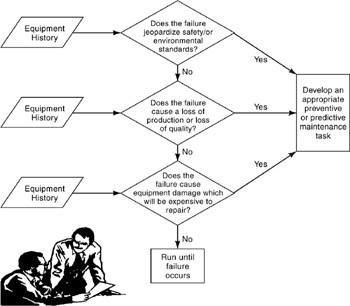
Reliability Centered Maintenance (RCM) is an evolutionary approach to equipment reliability. It focuses on the optimization of the preventive and predictive maintenance programs to increase equipment efficiency (uptime, performance, and quality) while minimizing the related maintenance costs. The RCM approach can be highlighted by the decision tree in Figure 10-1
In the decision tree, the consequences of failure are taken into consideration when evaluating the preventive and predictive maintenance tasks. For example, if a regulatory issue, such as the safety of an employee or the environment, would be endangered by the failure, the preventive and predictive programs would be modified in such a way that the consequence could:
be prevented by proper preventive maintenance
be monitored by predictive techniques, so the time of the failure could
be identified and the defective component could be changed before the failure occurred
be designed out by changing the equipment design to eliminate the component that would have failed
If the failure would cause a major production stoppage or process loss, then the same process would be applied to eliminate the problem.
If the answers to the first two decision tree questions are no, then the last question is: Would the failure cause considerable damage to the equipment and be expensive to repair? If yes, then...