Digital Filters Design for Signal and Image Processing

Chapter 3: Frequential Characterization of Signals and Filters

Chapter written by Eric GRIVEL and Yannick BERTHOUMIEU.

3.1. Introduction

This chapter discusses frequential representations of signals and filters. We will introduce the Fourier transform of continuous-time signals by first presenting the Fourier series decomposition of periodic signals. Properties and basic calculation methods will be demonstrated. We will then present the frequential analysis of discrete-time signals from the discrete Fourier transform using the standard and most rapid versions. These concepts will then be illustrated using the example of speech signals from a common time-frequency-energy representation the spectrogram.

3.2. The Fourier Transform of Continuous Signals

3.2.1. Summary of the Fourier series decomposition of continuous signals

3.2.1.1. Decomposition of finite energy signals using an orthonormal base

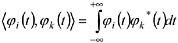
Let x(t) be a finite energy signal. We consider the scalar product of two functions ? i (t) and ? k (t) of finite energy, represented as follows:

(3.1)

where ? k * (t) denotes the complex conjugate of ? k (t).

A family { ? k (t)} of finite energy functions is called orthonormal if it verifies the following relations:

(3.2)

A family { ? k (t)} is complete if any vector of the space can be approximated as closely as possible by a linear combination of { ? k (t)}. A family { ? k (t)} is termed maximal when the sole function x(t) of orthogonal finite energy throughout ? k (t) is the null function. We can then decompose the signal x(t) on...

UNLIMITED FREE
ACCESS
TO THE WORLD'S BEST IDEAS

SUBMIT
Already a GlobalSpec user? Log in.

This is embarrasing...

An error occurred while processing the form. Please try again in a few minutes.

Customize Your GlobalSpec Experience

Category: Audio Analyzers
Finish!
Privacy Policy

This is embarrasing...

An error occurred while processing the form. Please try again in a few minutes.